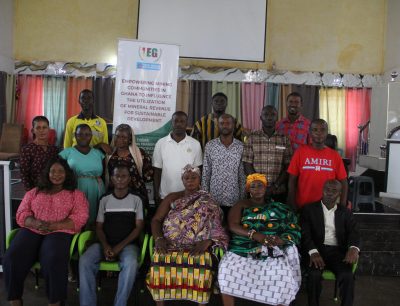
LEG trains stool land revenue utilization volunteers

Modern Ghana | By Richard Kofi Boahen

A two-day capacity building workshop aimed at empowering mining communities to contribute toward the judicious utilization of mineral revenue has taken place in Sunyani.

The workshop, which was held under the theme: “Promoting transparency and participatory governance of mineral revenue utilization through volunteerism”, formed part of a one-year project in three mining communities in the Asutifi North District of the Ahafo Region. It also aimed at empowering these communities to influence the utilization of mineral revenue for sustainable development.

This project seeks to empower Stool Land Revenue Utilization Volunteers in the three mining communities namely Kenyasi Number One, Kenyasi Number Two and OLA Resettlement site with the necessary knowledge and skills to mobilize their communities to actively participate and influence decision-making processes related to the utilization of mineral revenue towards initiatives that promote socio-economic well-being of citizens in the Asutifi North District.

The project is being implemented by the Livelihood & Environment Ghana (LEG) in partnership with Advocacy for Gender, Environment and Social Support (AGESS), with funding from STAR Ghana Foundation.

Mineral revenues

A lecturer at the Department of Environmental Management of the University of Energy and Natural Resources, Dr. Samuel Kumi, took the participants through the concept of mineral revenue utilization, types of mineral revenue to mining districts, regulatory framework for mineral revenue streams, rationale of mineral revenue payment to communities as well as the strategic importance of community information and monitoring of the mineral revenue utilization.

Dr. Kumi, who is also Environmental Scientist and Resource Governance Expert, mentioned ground rent, mineral royalties, property rates paid by mining companies and moneys accruing to the Mining Development Fund as some of the sources of mineral revenue to mining districts.

He said mineral revenues to mining districts are expected to mitigate the overly under-development and poverty, serve as general compensation of the impacts of the mining activities and reduce inequality, among others.

Commendation

The lecturer commended the volunteers for opting to track and report on the utilization of mineral revenue and said this will go a long way to promote transparency and accountability, sustainable development, and enhance trust and legitimacy.

“Mineral resources are finite or in fixed supply, and so are their revenue flow. It requires prudent and efficient utilization of the revenue to guarantee sustainable benefits from the mineral extraction. There is an urgent need to monitor and be involved in mineral revenue utilization at the local level”, he stated.

Visibility

Dr. Kumi further stated that there is the need for equal visibility and sustainable utilization of mineral revenue to the MMDAs and the traditional authorities to ensure a balanced focus on efficient utilization since both are paid almost equally.

Mr. Richard Adjei Poku, the Executive Director of LEG, inaugurated the volunteers as part of the programme.

LEG is a research and advocacy not-for-profit and non-governmental organization established in 2004 to promote community rights, environmental justice, sustainable livelihood and extractive sector governance and issues on health.

Read Original Source Here: https://www.modernghana.com/news/1338590/leg-trains-stool-land-revenue-utilization-voluntee.html

adminacc
    Leave a Comment

    Your email address will not be published. Required fields are marked *

    Similar Posts

    Stakeholders commit to transparency, accountability in utilization of Mineral Development Revenue in Asutifi North

    Stakeholders commit to transparency, accountability in utilisation of Mineral Development Revenue in Asutifi North
    Mining Pollution and Water Contamination in Ghana’s Mining Communities
    Mining Pollution and Water Contamination in Ghana’s Mining Communities

    Mining remains one of the most important sectors of Ghana’s economy. The country is globally recognized for its gold p

    Director urges use of mining revenue to tackle long-term development needs of local communities

    Director urges use of mining revenue to tackle long-term development needs of local communities

    Bottom Image